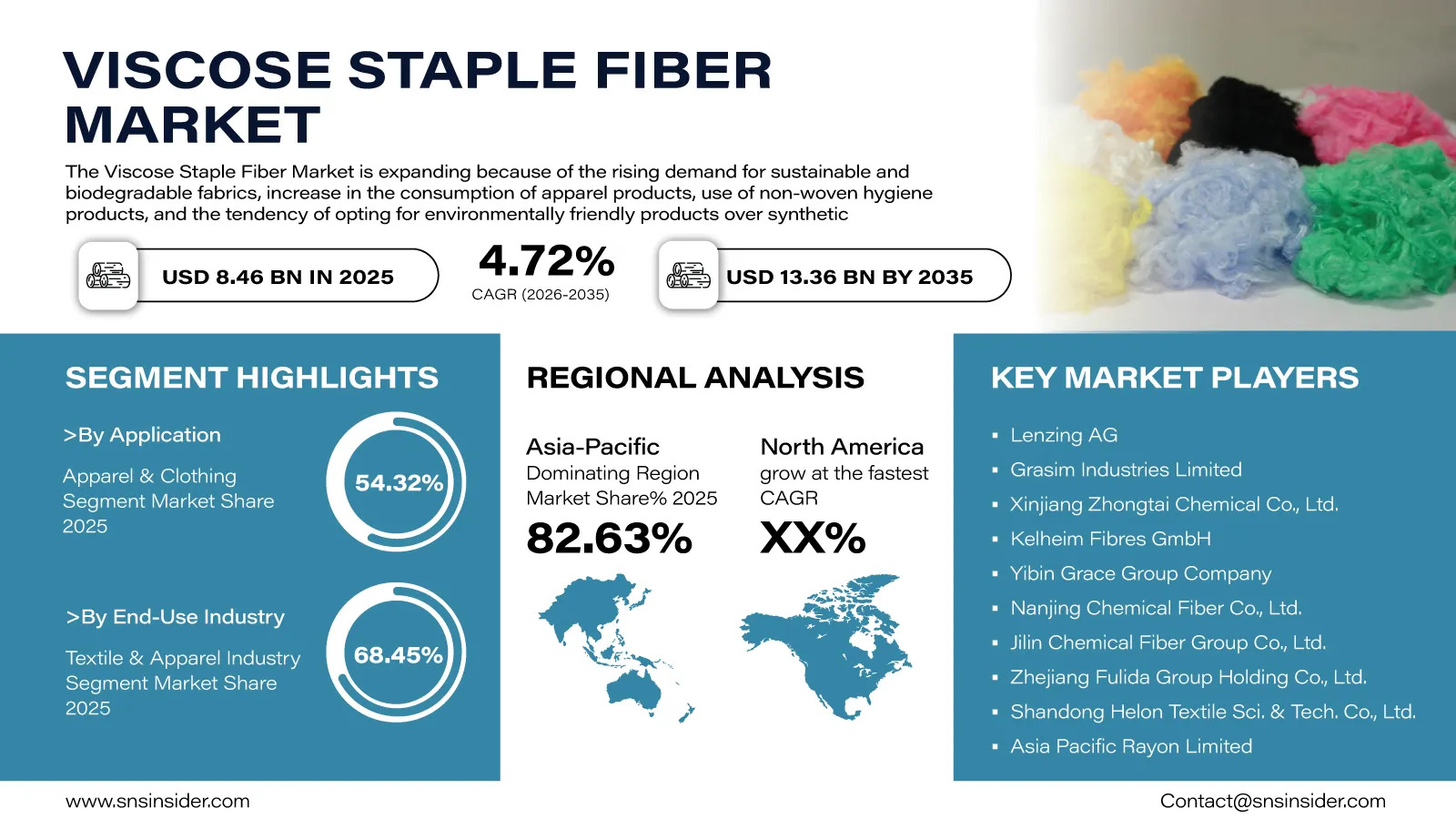
The global market for Viscose Staple Fiber will grow steadily as more textile manufacturers will start to value sustainable raw materials and environmentally friendly manufacturing processes.“According to a recent study by SNS Insider, the global Viscose Staple Fiber Market size valued at USD 8.46 billion in 2025, is anticipated to grow to USD 13.36 billion by 2035, registering a CAGR of 4.72% over the 2026–2035 forecast period.”
The increased awareness of consumers about sustainable fashion and circular textile manufacturing is prompting companies to move away from synthetic fibers to bio-degradable fibers. Viscose staple fiber has become an ideal choice for these reasons: it is soft, breathable, absorbs moisture, and can be used in all kinds of apparel and home textiles.
To Get Detailed Insights on the Viscose Staple Fiber Market – Request a Free Sample Report (https://www.snsinsider.com/sample-request/10090)
Growth in investment in textile production, especially in Asia-Pacific, along with the growing demand for high-end textiles and non-wovens, is set to drive market growth. Innovation in fiber technology has allowed manufacturers to create high-performance specialty grades of viscose with superior strength and durability.
Sustainable Textiles and Nonwoven Products Create Long-Term Growth Opportunities
The growing trend towards green manufacturing processes around the world is creating huge potential for manufacturers of viscose staple fibers. Fashion companies and textile manufacturers have increasingly adopted sustainable raw material practices, which are increasing the use of recycled cellulose fibers within their offerings.
Increased demand from the hygiene industry is also contributing to the rapid growth in the market. Higher usage of disposable wipes, baby diapers, and personal care items has led to an increase in the requirement for high performance non-woven fabrics.
Manufacturers are making investments in cleaner manufacturing practices, certified wood pulp, and closed-loop manufacturing processes in order to minimize the environmental footprint and improve process efficiencies.
Key Market Insights Highlight Changing Demand Patterns
Based on types, regular and standard viscose staple fiber dominated with 62.48% market revenue in 2025, owing to its wide applicability in the manufacture of apparel, home textiles, and general textiles. The modified and specialty fiber type will be the fastest-growing category from 2025 to 2035 owing to rising demand for flame-resistant, high tenacity, microfiber, and solution-dyed fiber grade.
According to end-use applications, the apparel and clothing category contributed 54.32% market revenue in 2025, driven by the rising consumption of fashion apparel globally coupled with increasing preference towards comfortable natural feel fabric. The industrial textile category will record the highest growth from 2025 to 2035 owing to rising use of automotive, filtration, and technical textiles.
Based on end-use industries, the textile and apparel industry held 68.45% market share in 2025. However, the healthcare and medical category is estimated to grow at the fastest rate over the forecast period owing to rising use of viscose-based nonwoven products in hygiene, medical, and healthcare applications.
Fiber Innovation Accelerates Industry Transformation
Innovation in technology is continuing to change the viscose staple fiber industry through creation of high-performance fibers that provide enhanced softness, tensile strength, uniformity in color, and durability. Specialized fibers for luxury clothing, industrial fabrics, automobile interiors, and health-care applications are creating additional profit streams for the companies.
The principle of sustainability plays a critical role in the product development process. Firms are increasing the efforts to source certified raw materials, create sustainable production processes, and adopt environmentally friendly chemical recovery systems that will contribute to the global sustainability goals.
In light of the growing focus of textile brands on traceability and sustainable sourcing within their supply chain operations, there will be an increase in the demand for certified viscose fibers globally.
Regional Markets Demonstrate Diverse Growth Opportunities
Asia Pacific held 82.63% share of total market revenue in 2025 due to the region’s well-established textile manufacturing industry, substantial production capacity, and high internal demand. China dominates the global market in terms of viscose staple fiber production and consumption, whereas India continues to gain prominence due to its growing textile manufacturing and hygiene products production.
North America experiences steady growth, mostly due to increasing demand for nonwoven fabrics employed in the manufacture of hygiene products, healthcare items, and industrial wipes. Rising consumer preference for environmentally-friendly textile products is another factor behind the expansion of the regional market.
Europe is still the market with the advanced technologies and characterized by high demand for specialty fibers, luxury fashion, medical nonwovens, and automotive textiles. At the same time, Latin America and the Middle East & Africa have been identified as promising growth markets due to rapid investments in textile manufacturing, garments, and personal care products industries.
Industry Participants Focus on Sustainable Production and Specialty Fibers
The competitive landscape of the international viscose staple fiber industry is more and more becoming one characterized by sustainable production, specialized products, production capacity increases, and certification of supply chain processes. Major players in the business are still focusing on green production technology as well as new products that satisfy the needs of their customers.
Key companies operating in the global Viscose Staple Fiber Market include Lenzing AG, Grasim Industries Limited, Sateri Holdings Limited, Tangshan Sanyou Chemical Fiber Co., Ltd., Xinjiang Zhongtai Chemical Co., Ltd., Kelheim Fibres GmbH, Yibin Grace Group Company, Nanjing Chemical Fiber Co., Ltd., Jilin Chemical Fiber Group Co., Ltd., Zhejiang Fulida Group Holding Co., Ltd., Shandong Helon Textile Sci. & Tech. Co., Ltd., Asia Pacific Rayon Limited, Century Rayon, Acelon Chemicals & Fiber Corporation, Xinxiang Bailu Chemical Fiber Group Co., Ltd., Shandong Gaomi Silver Hawk New Materials Co., Ltd., Anhui Somet Fiber Co., Ltd., Aoyang Technology Co., Ltd., Shandong Bohi Industry Co., Ltd., and Manasi Shunquan Industry Co., Ltd.
An SNS Insider analyst Himanshu Sharma commented, “Growing demand for sustainable textiles, expanding nonwoven applications, and continuous innovation in specialty fiber technologies are reshaping the viscose staple fiber industry. Companies investing in environmentally responsible production, certified sourcing, and high-performance fiber development are expected to strengthen their competitive position as global textile manufacturers accelerate the transition toward more sustainable materials.”