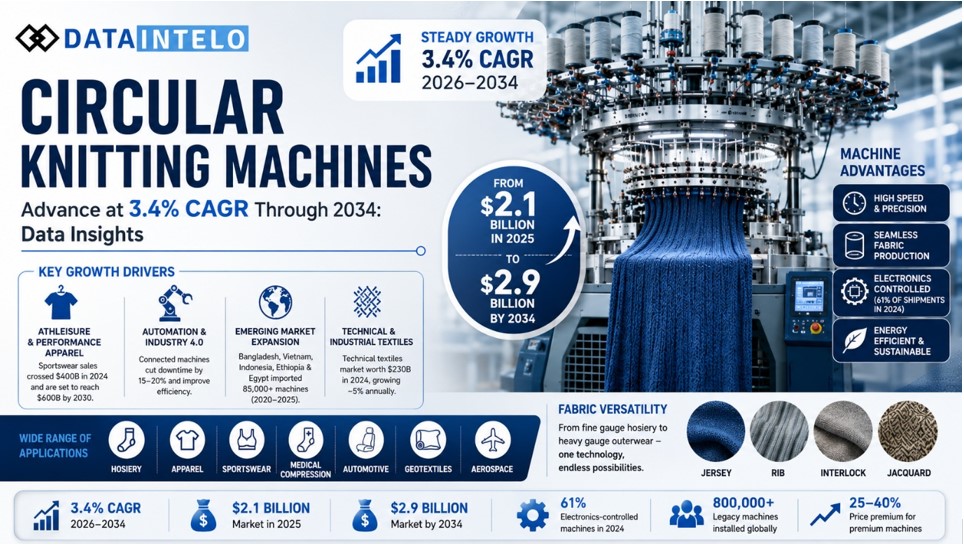
The future growth period for circular knitting machines will span a decade. According to a report published by DataIntelo in the current sizing, the value of the market of the product is estimated to be worth $2.1 billion in 2025 while aiming to reach $2.9 billion in 2034 – with a compound annual growth rate of 3.4% during 2026-2034. However, beneath the figures is a market segment that is being impacted by automation, sustainability trends, source location changes, and an expanding application scope that goes beyond T-shirts and hosiery.
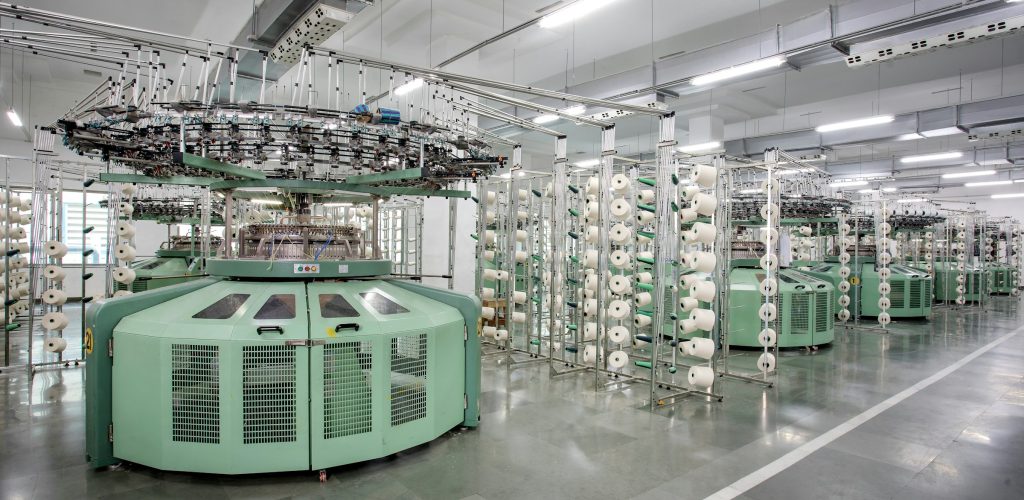
A circular knitting machine creates a seamless tube of fabric using the feeding of yarn into a rotating cylinder via needles, operating at high stitch speed with an enormous variety of gauge – from rugged gauge construction of outerwear garments to the fine gauge of hosiery. The cam or electronically actuated needle selection systems used enable the same basic machine design to produce jersey, rib, interlock, and jacquard fabrics – thus forming the heart of such a large portion of the knitted fabric supply chain.
Recent Developments Transforming the Segment
A few concrete shifts stand out from the last two to three years. Connected-machine platforms have moved from novelty to standard offering, with established European builders streaming production speed, yarn consumption, needle condition, and fabric-weight data to centralized dashboards, reportedly cutting unplanned downtime by 15–20% where deployed at scale. A Taiwan-based manufacturer’s IoT machine-management software was adopted by more than 120 fabric mills globally within roughly a year of launch, signaling real appetite for digital retrofits rather than just new-machine bundling. Also, seamless knitting machines have earned their place in the market through the advantages they offer in intimate apparel, base layers, and medical compression wear – making up approximately 12% of global machine revenues. Also, electronics-controlled machines have comprised around 61% of global shipments compared to 47% in 2020 since pattern changeovers are much faster than traditional mechanical methods using cams. Moreover, Chinese and Taiwanese suppliers have been able to close the quality gap significantly compared to established European suppliers such as Germany and Italy while selling their products at much cheaper prices.
Outlook Through 2034
A 3.4% compounded annual growth rate may not seem very impressive when compared with other rapidly developing technologies, but compared to the rest of the mature capital equipment industry, it is a healthy growth rate. Moreover, replacement demand plays a more important role than any increase in capacity; there are over 800,000 semi-automatic and manual machines currently installed in the world. Premiumization is also lifting revenue faster than unit volumes fully automated, IoT-enabled machines can command price premiums of 25–40% over conventional models and higher-value categories such as jacquard-capable double jersey systems are tracking growth well above the segment average, near 4% or higher annually.
Growth Determinants
Athleisure and performance apparel remain the single biggest demand engine. Worldwide sportswear sales have crossed $400 billion in 2024 and are set to touch $600 billion by 2030, with the knitted fabric accounting for much of that fabric content. The fine gauge jersey and jacquard constructions continue to be favored by compression sportswear and seamless sportswear manufacturers, and fabric mills catering to major sportswear manufacturers have invested hundreds of millions of dollars in one year alone.
The adoption of automation and Industry 4.0 technologies continues to gain momentum with rising labor costs and buyer demands for consistent quality and rapid changeovers. Larger textile groups are increasingly folding knitting hardware into broader manufacturing execution systems, and vendors are bundling proprietary software with machines — a shift that lifts average transaction values well beyond what unit counts alone suggest.
The capacity development aspect of developing countries is another significant motivator. Together, the five countries namely, Bangladesh, Vietnam, Indonesia, Ethiopia, and Egypt have spent more than 85,000 knitting machines during 2020-2025. In a recent year, Bangladesh imported over $180 million worth of equipment as it builds its knitwear backward-integration efforts, while Vietnam’s fabric forward trade agreement incentives are guiding investments towards knitting facilities.
Technical textiles and industrial textiles round off the list of applications. Circular knitting finds applications in medical compression stockings, filters, geotextiles, automotive upholstery, and aerospace pre-form composites, apart from apparel. The broader technical textiles category was valued near $230 billion in 2024 and is forecast to grow close to 5% annually through 2030, with medical compression wear tied to an aging population a particular bright spot.
Regional and Segment Patterns
Asia Pacific represents almost 52% of world revenue due to China’s vast installed capacity (above 600,000 machines) and the textile industry incentive in India, along with its knitwear clusters of Tirupur, Ludhiana and Surat, which are boosted by high rates of installations in Vietnam and Bangladesh due to diversified sourcing. Europe comprises nearly one-fifth of global revenue due to its demand from Germany, Italy, and Switzerland, which is predominantly replacement-based. North America accounts for almost 14% of revenue and is dominated by technical, medical and protective-apparel uses, whereas Latin America and Middle East/Africa represent the rest of regions, with Brazil, Turkey, and Egypt as regional centers.
Single jersey machines continue dominating in terms of installed volume with nearly 38% share because of their flexibility and affordability. Double jersey machines hold roughly 28% and are growing faster than average as stretch-performance fabrics gain ground, while jacquard-capable variants are smaller in share but the fastest-growing category overall. By application, athletic fabric production is both the largest and fastest-growing use case, ahead of general apparel and industrial/technical textiles.
Regulatory and Policy Factors
Regulation plays a bigger role here than often appreciated. Government-backed textile-park financing in China, and India’s incentive program covering roughly INR 10,683 crore, have directly translated into new machine orders. Trade-agreement architecture matters too: Vietnam’s fabric-forward rules of origin under its EU trade pact are pushing investment toward local knitting capacity. On the constraint side, tightening EU energy-efficiency standards for industrial machinery are pushing OEMs toward costlier re-engineering, and US-China trade friction introduces tariff uncertainty for cross-border machinery flows. Volatility of currency in both Bangladesh and India often constrains import budgets despite continued demand.
Competitive Landscape and Expert Opinions
The competition landscape is grouped into three segments: a European high-end construction brand competing on accuracy and service; a Taiwanese segment offering quality versus price and with regional services; and a Chinese segment competing on price and delivery times. The top five manufacturers hold an estimated 38–42% of global revenue, with a long tail of more than fifty producers taking the rest. Industry observers increasingly frame the next decade as a contest over the digital layer sitting on top of the hardware software, remote diagnostics, and data services rather than the machine itself. That view lines up with buyer behavior: large enterprises, roughly 62% of procurement value despite being a minority of buyers by count, are disproportionately adopting fully connected configurations.
Case snapshots: An Italian manufacturer’s seamless circular platform has become a reference point for gradient compression garment production, eliminating seams that create pressure points. For instance, a machine management software developed by an entrepreneur from Taiwan and introduced in the year 2024 was used by more than 120 textile mills within a year. Likewise, there is an Indian textile incentive scheme that has received support via an allocation of over INR 10,683 crore, highlighting the influence that a particular instrument of policy can have on machinery purchases within an entire cluster.
Issues and Opportunities ahead
Friction is always a part of every story. The existence of an abundant stock of used and refurbished machinery in decommissioned factories in Europe and Japan provides a competing force for the sale of new machinery. There is shortage of skilled labor for the running of these advanced electronic machines. Cyclical apparel-sector spending also means equipment orders can swing more sharply than end-consumer demand for knitted goods would suggest.
In the future, the automation retrofit kit for the existing fleet of manual equipment presents a capital-light growth opportunity beyond sales of new units. Compatibility with recycled and bio-based fibers represents a true point of differentiation for brands moving forward on their sustainable fabric range. Smart textiles and e-textiles, including yarns suitable for knitting, represent a growing niche market. The lack of penetration of certain regions of the world, such as Sub-Saharan Africa within the African Continental Free Trade Area, represents a long-term opportunity as textile parks financed through development aid are developed.
Decision-Making Highlights
Three points matter most for procurement and strategy teams. The first aspect is that the pace of growth in the industry has become consistent, without the sudden spurt in the number of machines, and the focus is more on high-end products rather than sheer volume. The second aspect is that the geographic spread of the industry is undergoing change slowly and steadily, with countries like Vietnam, Bangladesh, and parts of Africa gaining traction in terms of installations alongside the dominant China market.
Author – Ashish Kolte is a Marketing Manager at DataIntelo with expertise in marketing, market intelligence, and business strategy. He combines marketing insights with industry research to analyze market trends, identify growth opportunities, and provide data-driven perspectives on emerging industries and global business developments.