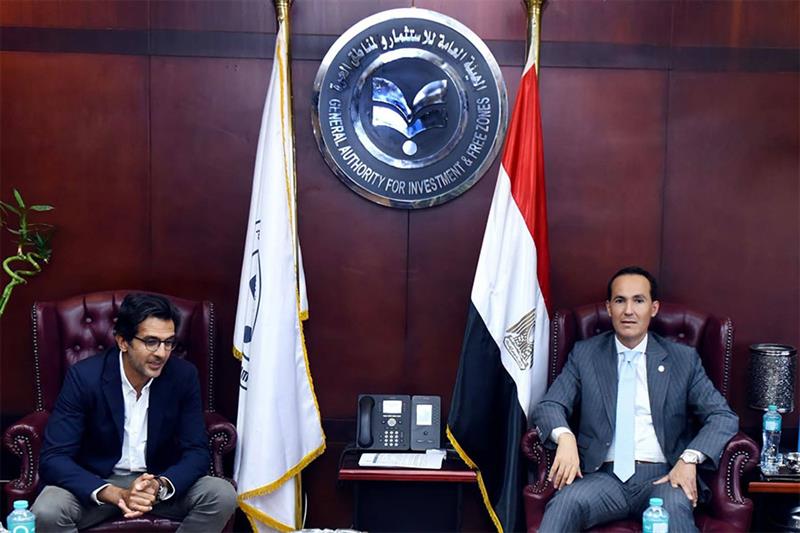
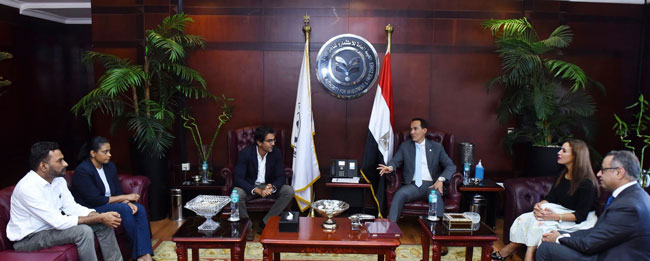
Egypt’s General Authority for Investment and Free Zones (GAFI) hosted Sri Lankan private and multinational conglomerate Hirdaramani Group to discuss the firm’s expansion plans in the Egyptian ready-made garments and textile market, according to a statement by the Ministry of Investment and Foreign Trade released on Thursday.
The group is a family-owned firm founded in 1890, specializing in end-to-end apparel manufacturing and design solutions for global fashion brands. It has also recently branched out into renewable energy, IT, retail, and leisure development projects. The group currently operates more than 30 textile factories across several countries, employing over 55,000 people. The company’s annual revenues are around $1.2 billion, while its monthly production ranges from 12 to 18.4 million garments exported to global markets.
The meeting aligns with the state’s National Industrial Strategy, which aims to position Egypt as a regional production and export hub by increasing exports and deepening local manufacturing and components.
During the first four months of 2026, Egypt’s ready-made garment exports rose 15 percent year-on-year to $1.15 billion, compared to $1.002 billion in the same period last year.
In 2025, ready-made garment exports increased 20 percent to $3.394 billion from $2.846 billion a year earlier.
Furthermore, Hirdaramani sees Egypt as a “strategic platform for expanding the company’s production and exports to other markets,” according to the group’s Director Sid Hirdaramani. In its expansion plan, the firm will rely on incentives provided by the Egyptian government to investors in the textile sector and the marked improvement in the country’s investment climate. The Sri Lankan group has not, however, disclosed any further details or timelines.
Egypt relies heavily on the private sector to achieve its economic goals amid recent global challenges and their impact on the economy. According to Egypt’s 2026/2027 fiscal year budget, the government aims to attract investments valued at EGP 3.7 trillion. The government’s plan also targets increasing the private-sector contribution to these investments to 59 percent (EGP 2.2 trillion). It also projects investments constituting 17 percent of the country’s GDP. The state is also working to attract value-added investments and support feeder industries to reduce production costs and improve the competitiveness of Egyptian products.
Moreover, according to GAFI Chairman Mohamed Awad, the authority aims to attract global companies in export industries to enhance the integration of the Egyptian economy into global supply chains, especially in the textile and ready-made garment sector, by developing a network of local suppliers capable of providing production inputs according to the highest international quality standards.
The local textile and ready-made garment sector has recently attracted several private and international investments, including companies based in Hong Kong, China, and Turkey, to Egypt’s industrial and economic zones, mainly in the Suez Canal Economic Zone (SCZone) and the Qantara West Zone.