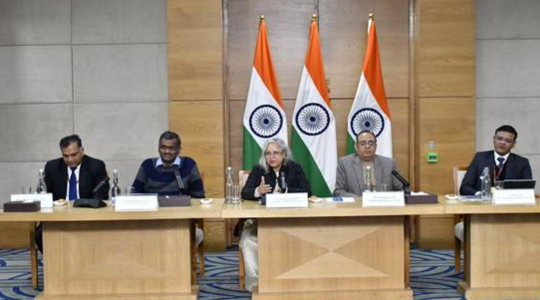
 National Industrial Corridor Development Corporation (NICDC), in association with Ministry of Textiles, conducted a stakeholder consultation meet to explore partnership opportunities for the development of PM Mega Integrated Textile Region and Apparel (PM MITRA) Parks being established under the Design, Build, Finance, Operate and Transfer (DBFOT) model. This consultation is part of an ongoing series of market sounding engagements aimed at refining a robust, market-aligned framework to support timely and effective implementation.
PM MITRA Parks under DBFOT (PPP – Greenfield)
The consultation meet specifically focused on engaging prospective Master Developers for three Greenfield parks proposed under PPP/DBFOT:
• Lucknow, Uttar Pradesh (1,000 acres): Strong multi-modal access, including proximity to major transport nodes.
• Kalaburagi, Karnataka (1,000 acres): Site located close to NH50 with connectivity to major regional hubs.
• Navsari, Gujarat (1,142 acres): Strategic connectivity to ports/logistics; road, rail, and airport access.
Key highlights from the consultation
In her address, Smt. Neelam Shami Rao, Secretary- Ministry of Textiles (MoT) shared her valuable suggestions with the stakeholders and encouraged their active participation in shaping a strong, collaborative framework for the successful development and implementation of PM MITRA Parks
Shri Rohit Kansal, Additional Secretary, MoT underscored the strategic intent of PM MITRA as a transformational initiative, noting that they are being developed as large, integrated textile parks of a minimum 1,000 acres each. He noted that DPRs amounting to approximately ₹5,567 crore have already been finalized across the 3 States proposed under the PPP mode.
Shri Rajat Kumar Saini, CEO & MD, NICDC highlighted the 5F Vision of PM MITRA Parks and the strong industry response to the PM MITRA initiative, with investor interest exceeding ₹20,054 crore in the 3 states, driven largely by the composite textile segment. He outlined the Government’s focus on enabling globally competitive infrastructure, including plug-and-play industrial facilities, testing laboratories, single-window clearances, integrated logistics, social infrastructure, and reliable grid-connected clean power. He emphasised that PM MITRA Parks are designed to enable end-to-end value chain integration and globally benchmarked manufacturing ecosystems.
Constructive stakeholder feedback and way forward
The consultation witnessed wide participation from prospective domestic & international master developers and industry stakeholders. Discussions focused on utilities planning, including steam systems, CETP/ZLD integration, modular plot development, and ensuring an ecosystem that supports both MSMEs and large anchor units.
Shri Kansal noted that such consultations will be instrumental in identifying gaps, which can be deliberated upon to develop a robust mechanism for the textile sector, while commending the Ministry of Textiles’ efforts in strengthening the sector and improving livelihoods.
Shri Saini indicated that the exercise would support validation of market interest, refinement of the Master Developer model, improved project structuring and bankability, early risk identification, infrastructure phasing, investor attraction strategies, benchmarking with global best practices, and enhanced bid readiness contributing to timely development and successful operationalisation of PM MITRA Parks.
Overall, the consultation reflected strong stakeholder confidence in the PM MITRA scheme. Participants expressed optimism about its design and implementation approach, and the session benefited from constructive feedback and actionable suggestions, which will help further refine the framework and strengthen the way forward for successful delivery of PM MITRA Parks.