The Shift: From screen-heavy to smart integration
The transition did not happen by replacing screen printing. It happened by optimizing it.
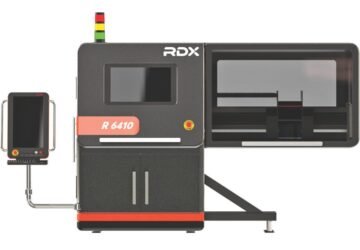
Typical hybrid workflow in Tirupur today:
• White paste or discharge executed through screen.
• 1–3 screens instead of 8–10.
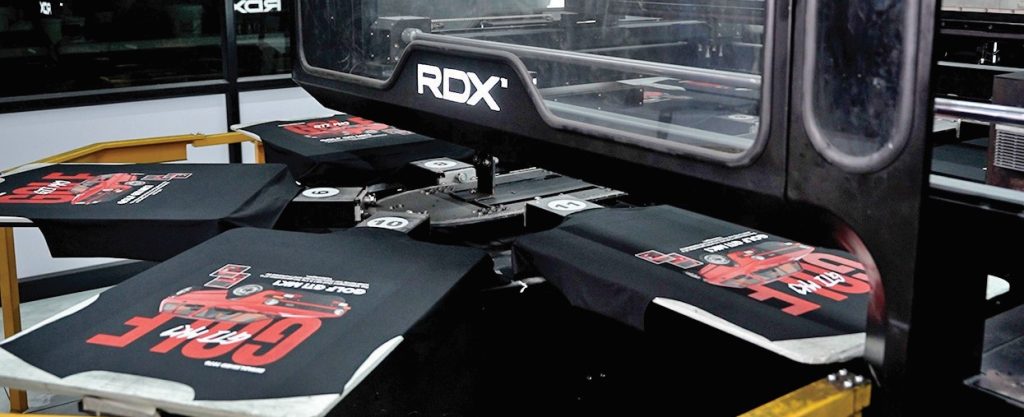
• Complex multi-colour artwork handled digitally.
• Specialty finishes (puff, foil, high density, shimmer) retained in screen.
• Setup time: 30–45 minutes.
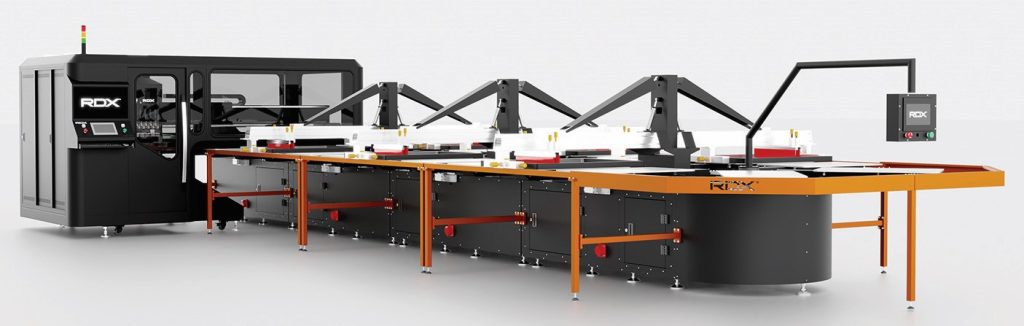
• Integrated directly onto automatic carousels.
The result: lower screen dependency, fewer manual adjustments, and faster job stabilization.
What exporters experienced
Mr. Babu, Aara Tex Exports “Earlier, high-colour jobs meant heavy preparation and skilled alignment pressure. With hybrid, production flow has become smoother. Screen room workload reduced. Repeatability improved.”
Mr. Sasikumar, Aura Printers “Skilled labour shortage is real. Hybrid has helped us reduce dependency on high-precision registration experts. Complex export designs are now easier to execute without slowing production.”
These insights reflect a broader industry pattern: hybrid systems are reducing operational friction.
Why hybrid found ground in Tirupur
1. Labour & skill constraints
• Registration experts are limited.
• Wage costs are rising.
• High-colour exports increase complexity.
By shifting intricate colour separations to digital while retaining strong base layers in screen, factories reduce manual calibration pressure and production variability.
 2. Setup efficiency & flexibility
• Reduced screen count.
• Faster artwork changeovers.
• Lower screen room congestion.
• More predictable production timelines.
Factories handling mid-sized export orders report smoother batch transitions and fewer rework cycles.
3. Export-driven agility
Tirupur operates on tight buyer timelines. Artwork revisions are frequent. Design complexity continues to increase.
Hybrid enables:
• Digital artwork adjustments without remaking multiple screens.
• Faster strike-offs.
• Controlled colour consistency across batches.
• This directly strengthens export responsiveness.
A production-first evolution
Hybrid digital printing has not spread through marketing campaigns. It has spread through factory-to-factory observation. One exporter improves setup efficiency. Another notice is reduced downtime. Adoption follows results. The industry’s discipline remains intact: automatic carousels, structured workflows, high daily outputs. Hybrid simply enhances colour execution within that system.
The real outcome
• Reduced dependency on high-skill manual registration.
• Lower screen preparation load.
• Faster transitions between export styles.
• Stable repeatability across batches.
• Stronger margin protection in fluctuating markets.
Hybrid digital printing is not positioned as a replacement technology. It is a production strategy, one that aligns with modern export complexity.
Tirupur’s strength has always been intelligent adaptation. Hybrid integration is another example of that maturity. The shift is not loud. But on the factory floor, it is measurable
(By Deepak Siddharth, Founder & CEO – RDX Digital Technologies)


 2. Setup efficiency & flexibility