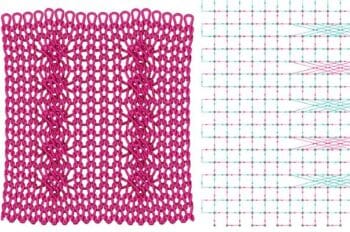
 Academics at Drexel University in Philadelphia have developed a computer modelling system capable of mapping the paths of yarns in the manufacture of knitted fabrics. The team believes the solution could significantly improve manufacturers’ abilities to integrate material-based technologies, as they’d first have detailed insights into the garment production cycle with which they could make targeted changes.
“In order for these [technical] textiles to be widely deployed and reach their full industrial potential, computer-based modelling and simulation tools must be developed to support the design and optimisation of knitted structures,” noted David Breen, a Professor in Drxel’s College of Computing and Informatics.
The researchers insist that one of the greatest barriers to the full integration of technology within textiles is the current software used for design, which they say lacks the “thread-level detail necessary for digital sampling and precision manufacturing”.
To address this, the team made TopoKnit, a suite of algorithms they developed as a tool for modeling the path of a yarn within a knitted textile. Whilst the team admits the technology doesn’t address all computer modelling issues, they believe it can provide a more in-depth overview of the manufacturing process, documenting how each yarn is assembled to construct a fabric.
Breen believes the technology comes at an opportune time for the apparel sector, as knitted fabrics are increasing being used for functional fabrics instead of woven materials. Leveraging the system then, companies could fine-tune their processes to meet exact specifications.
To put the technology to the test, the academics worked closely with their peers at the university’s Center for Functional Fabrics to generate a series of 100 patterns which were logged using TopoKnit. The team compared each graph to its corresponding graphic rendering to see if the stitch map matched the rendered model. The graphs were an exact match in each case, the academics reported, showing that the TopoKnit system could be used to reliably produce manufacturing instructions for knit textiles via a sequence of steps that produces specific yarn topologies.
These topologies, descriptions of how the yarns contact and interconnect with each other, allowed the system to flag stitch patterns in a design that would not be viable in production, which is an important step for prototyping. While the accuracy of TopoKnit is important, Breen noted that it is still just the first of many steps towards a textile modelling programme that has the potential to represent and simulate functional fabrics.